Image and video hosting by TinyPic

Labels

Showing posts with label Android. Show all posts

Samsung Captivate Glide Review

Written By Info mobile on Thursday, November 24, 2011 | 6:49 PM

Samsung Captivate Glide Review
Android Version: 2.3.5
Kernel Version: 2.6.36.3
Build Number: GINGERBREAD.UCKI3

Samsung Captivate Glide Video Review:


Introduction:

Before rushing to judgment, don’t let its model name fool you for one bit, well, that’s because the Samsung Captivate Glide isn’t merely a rehashed device with a physical keyboard. Rather, it’s a transitive smartphone that’s tastefully modernized, thanks to its hardware, to meet the demands of power and elite users all around. In fact, it boasts a snazzy looking Super AMOLED display, dual-core processor, HSPA+ connectivity, and an always useful landscape style keyboard – all packaged together for a reasonable $149.99 with a 2-year contract.


Samsung Captivate Glide Review
The package contains:

  • microUSB cable
  • Wall Charger
  • Quick Start Guide
  • Health & Safety and Warranty Guide

Design:

For starters, it doesn’t look exactly like a Samsung Captivate with a physical keyboard attached to it, nor does it bear any striking resemblance to Samsung’s line of Galaxy S II smartphones, but instead, the Captivate Glide is a totally different looking handset on its own. Constructed out of plastic, it’s nice to see that it’s rather compact in form (0.5” thick) and lightweight (5.2 oz) in the hand, but it tends to give it an overall flimsy build quality – though, it’s not that bad at all.

Constructed out of plastic, it’s nice to see that the Samsung Captivate Glide is rather compact in form and lightweight in the hand - Samsung Captivate Glide Review
Constructed out of plastic, it’s nice to see that the Samsung Captivate Glide is rather compact in form and lightweight in the hand

Samsung Captivate Glide Review

You can compare the Samsung Captivate Glide with many other phones using our Size Visualization Tool.

Just like the Captivate before it, the handset features a 4” WVGA (480 x 800) Super AMOLED panel that delivers a lot of eye-candy right from the start thanks to its high-contrast, overly saturated color production, wide-viewing angles, and average details. No, it’s not a Super AMOLED Plus panel, but nevertheless, it’s able to reel our eyes from afar thanks to its polarizing glow. As much as we’re entranced by it, we’re still finding ourselves shielding it from the sun to make out what’s on screen.

Front - Samsung Captivate Glide Review
Samsung Captivate Glide Review
Android capacitive buttons - Samsung Captivate Glide Review
Front
Android capacitive buttons
Thankfully, it doesn’t require much force to expose its 4-row landscape style keyboard seeing that its mechanism is very springy in nature. Despite the flat and nearly flush appearance of its keyboard buttons, our thumbs are able to type away with relative ease thanks to their sufficient size and tactile response. After some practice, we get into the groove of typing with minimal mistakes – plus, it’s nice that we have access to the usual set of Android buttons and a directional pad with its layout.

The 4-row landscape keyboard - Samsung Captivate Glide Review
The 4-row landscape keyboard

Since the set of Android capacitive buttons are placed very near to the bottom edge of the phone, we still find ourselves accidentally pressing them on occasion. Meanwhile, the handset’s earpiece and front-facing 1.3-megapixel camera are located above the display.

Around its sides, we find its microphone, volume rocker, dedicated power button, 3.5mm headset jack, and a plastic sliding cover that hides away a microUSB port. With the latter, you can use an optional MHL adapter to gain video-out functionality.

Bottom edge - Samsung Captivate Glide Review
Volume rocker (left) - Samsung Captivate Glide Review
Power key (right) - Samsung Captivate Glide Review
microUSB port and 3.5 jack (top) - Samsung Captivate Glide Review
Bottom edge
Volume rocker (left)
Power key (right)
microUSB port and 3.5 jack (top)
In the rear, its 8-megapixel auto-focus camera with LED flash and speakerphone notches lay flush towards the top side. Finally, removing the plastic cover provides us access to its SIM card slot, 1,650 mAh battery, and microSD slot.

Back - Samsung Captivate Glide Review
Camera - Samsung Captivate Glide Review
Battery compartment - Samsung Captivate Glide Review
Back
Camera
Battery compartment
6:49 PM | 0 Comment | Read More

Spesifikasi Tablet Android Relion RealPad 7 Inci

Written By Unknown on Sunday, November 20, 2011 | 9:27 PM

To compete in the world of Tablet PCs, Relion has recently launched its newest product is Relion RealPad 7 Inches. This is a new step Relion to be able to compete in the competition Tablet PC. Although still relatively new, but remains optimistic about its products Relion Tablet Android Relion RealPad 7 Inches. These tablets are intended for the medium.


Spesifikasi Tablet Android Relion RealPad 7 Inci:
  • Processor : Rockchip RK2918 Cortex A8 1.2GHz 518KB support Full HD
  • Memory : 512MB DDR3
  • Hard Disk : 8GB NAND Flash
  • Display : 7? 800 x 600 resolution (aspect ratio 4:3)
  • Display Type : Capacitive Touch Panel, 5 point Multi Touch
  • G-Sensor : Support 3D Games, Pictures, eBook
  • Connectivity : 802.11b/g/n draft WiFi network connection, Bluetooth 2.1 EDR
  • VGA : 2D/3D GPU supports Open GL ES 2.0, Open VG, and 3D
  • Camera : VGA 640 x 480 resolution
  • Speaker : D class embedded speaker
  • OS : Google Android 2.3.1 (Gingerbread)
  • Battery Life : Up to 10 hours for audio playback, 4-5 hours for video playing (depends on the resolution), and 7 hours for web browsing
9:27 PM | 0 Comment | Read More

Axioo Vigo 350 Dual SIM Mobile Android

Written By Info mobile on Tuesday, November 15, 2011 | 4:09 AM

Axioo Vigo 350 Dual SIM Mobile Android
Android mobile phone dual sim card more loved. Axioo Vigo 530 is one of them. Froyo Android-based phone is right for you who want a phone that can be inserted with two cards and can run concurrently (dual standby).
Advantages of Dual SIM Android phone. The ability of a cell phone to handle two sim simultaneously it is becoming a trend. Not only the young group Amendment with dual gsm mobile phone on. Even my grandmother also loved bergonta replace the card. The reason is simple; save phone charges. Grandmother's known among islands often make calls with the children and grandchildren. Quite often called one of his grandson grandmother who worked as a seaman when his ship passed the country of Somalia. He was so worried by the notorious Somali pirates and sadistic. 
 

Excess Axioo Vigo 350. One of the advantages of this phone is its ability to menanangi dual sim card simultaneously where each channel slot supports 3G sim card so users are free to use whichever card when trying to access the Internet. Unlike other local Android phones that only support one sim card slot for 3G channel. Another alternative connection media is Wi-Fi and Bluetooth to support EDR features.


Axioo Vigo 350
Specifications Axioo Vigo 350Dimension: 121.8 x 66.7 x 10.6 mmWeight: 143 grams with battery packScreen: LCD 3.5-inch transmissive TFT, 320 x 480 pixels, Colors 262K/65K Capacitive panelProcessor: Qualcomm MSM7227-1, ARM11 600MHzRAM: 512 MBOS: Android 2.2 FroyoInternal Memory: 512MB for storageExternal Memory: MicroSD slot up to 32GBCamera: 5 MP auto-focus, Geo-tagging, face and smile detectionMultimedia: MP3/WMA/WAV/eAAC + player, player MP4/WMV/H.263/H.264Communications: GPS / AGPSMessaging: SMS (threaded view), MMS, Email, Push Email, IMBrowser: HTMLData Transfer: GPRS, EDGE, HSDPA 7.2 Mbps, Wi-Fi 802.11 b / g / nConnectivity: 3.5mm audio jack, Bluetooth v2.1 + EDR, Micro USB v2.0Other Features: Flash Player, Document viewer, games, opera mini, Photo viewer / editor, Organizer, Voice memo, SNS integration, Google SearchBattery: Standard battery: Li-Ion 1500 mAh, Standby time: up to 350h, Talk time up to 6 hours
4:09 AM | 0 Comment | Read More

Latest Motorola Motorola Corvair Tablet that can be remote system using the Android 2.3 Gingerbread

Written By Unknown on Thursday, November 10, 2011 | 2:40 AM

Motorola will launch a tablet operating system Android 2.3 Gingerbread at once can be used as a television remote.
 
Tablet titled Corvair is not yet clearly known specifications. But leaked on the internet, Corvair wear Gingerbread Android 2.3 operating system, 6-inch touch screen, wifi and 4000 mAh battery.

As a remote control, Corvair and controllers have been equipped with infrared wireless network that uses radio application frequency (RF). Feature called Radio Frequency for Consumer Electronics (RF4CE) is a kind of Bluetooth, but only requires low power, low cost, no wasteful batteries and a secure network.

Not known a more detailed specification of this device. But the allegations circulating on the internet, Corvair device that is designed to be affordable and easily grasped. Corvair also touted as a device that ciamik in terms of design and the smallest in its class.

Google in August 2011 had purchased the Motorola Mobility for $ 12.5 billion U.S. dollars. Besides the focus to the smart phone business, Motorola Mobility also has a business set top boxes and modems.

The existence of the set top box business, will make Google to distribute video content to the television screen. In addition, of course, integration with other services like Google + as well as its ad business.
2:40 AM | 0 Comment | Read More

HTC Ville, First With Android 4.0 HTC Sense 4.0

Written By Info mobile on Wednesday, November 9, 2011 | 8:49 PM

After appearing Edge information related to HTC phones, now other news related to HTC's latest products re-emerged on the market. HTC is rumored to be releasing another phone that has the name HTC Ville.

This phone, rumors will be officially released on mobile world congress. Regarding its release to the market, HTC will likely do so in April.

HP is said to be 4.0 first Android phone to feature HTC's Sense 4.0. In addition, the phone also reportedly has a 4.3-inch super AMOLED screen with a resolution of 540 × 960 pixels. Regarding the processor, it is likely HTC will use dual-core Snapdragon processor.

In addition there is an 8MP camera on the back that can record video with 1080p quality. The phone has a body made ​​of iron, with a thickness of only 8 mm. There is also a radio facility HSPA + and comes with 1650 mAh battery.

Mobile World Congress itself was scheduled to be held on February 27 in Barcelona, Spain. Possibilities at the same time, HTC will release HTC Edge.
8:49 PM | 0 Comment | Read More

HTC Android Phone Plus Rezound Beats Audio

Written By Info mobile on Friday, November 4, 2011 | 9:43 PM

HTC officially announced the launch of its newest product with labels Rezound HTC, mobile phones based on Android 2.3 Operating System for the first phase will be marketed in the U.S. by Verizon Operator.

Rezound Mobile HTC HD has a screen of 4.3 inches with a resolution of 720 × 1280 pixels. Rezound been equipped with audio beats as which ones are the last products of other HTC, and it became Typically phones made ​​by HTC.

For the processor, Mobile Rezound powered dual-core Snapdragon 1.2 GHz, and equipped with 8 MP camera found on the back capable of recording 1080p video quality, while at the front of this phone, has also pinned by 1.3 MP camera for videocall needs and videochat.


For connectivity, have been equipped Rezound in 4G LTE mncapai promising download speeds of 5-12 Mbps. To support the performance, this phone is equipped with 1GB of RAM and a built in memory of 16 GB. HTC Rezound can be obtained through the operator Verizon starting November 14. Regarding the price, will likely be on bandrol around 300 USD.

According to information, the HTC Rezound will get the Android 4.0 update, however, no mention of OS updates on ice cream sandwich on this phone, The HTC promising beginning in 2012 Android is going to get ice cream sandwich on Rezound.
9:43 PM | 0 Comment | Read More

Tablet Android Rp1, 5 Million So Idol

Tablet devices are now becoming a trend among large lamsyarakat because it provides ease of service and convenience in accessing the data or surfing in cyberspace (browsing). In terms of design, the tablet represents a dynamic lifestyle and support the mobility of users in the move.

Interest Indocomtech 2011 visitors to the tablet purchase tablet recorded in the queue. Nexian in this exhibition provide a special promo price for their Android devices. Genius Tablet Android Froyo 2.2 A7500 priced Rp1, 499 million, half the normal price which reached Rp 3 million.

The new tablet measures 7 inches until the third day of the exhibition is already sold 500 units. Android Other products are also attractive to visitors.

Android Smartphone Ultra A891 Journey has sold over 800 units at a price of 749 thousand, the normal price Rp1.499 million. Wifi Router, MI FI priced at Rp499 thousand below the normal price of 1 million. Routers today it has sold 500 units.

"All of our discount of 50 percent, every day of the queue is full," said Centris Nexian Data Manager, Wirahadikusuma on the sidelines of the promo at Booth Nexian, JCC Senayan, Jakarta, Friday, November 4, 2011.

should Queue

Every day quota for Tablet Genius Smartphones 200 units and 400 units restricted Ultra Journey. Target until the end of 2500 the exhibition according to the Wira entirely to a third device that android device. "For Genius Tablet targets thousand units later, the rest for others," he said.


The enthusiasm of visitors who lined up, he says, has been seen since 9 o'clock this morning. Visitors are given bracelets as a sign of the queue.

Especially for MI FI Router does not apply since the queue is not as much interested visitors and Smartphones Ultra Tablet Genius Journey. To provide opportunities for visitors, the queue is divided into two stages, ie, morning and night. (ren)
5:34 AM | 0 Comment | Read More

Review LG Optimus 2x (P990) GSM/UMTS smartphone

Written By Info mobile on Friday, October 14, 2011 | 10:03 PM

Review LG Optimus 2x (P990) GSM/UMTS smartphone

Live photos of LG Optimus 2x

In the box

  • Phone
  • 1500 mAh Li-Ion battery
  • Charger
  • USB cable
  • Wired stereo headset
  • A CD with LG PC Suite
  • User Guide

Positioning

In 2010 Samsung chose Android models as their priority and paid special attention to its flagship Galaxy S. After its sales started the model became extremely popular and around 10 million items were shipped rather quickly, which is a sensation for the price segment. We do not take Apple iPhone into equation as it is unique and follows other rules with constant demand on the market. LG could not offer a single model to rival Samsung Galaxy S in 2010. As far as the company targeted Android as well and managed to become successful in mid-price segment with its Optimus line the absence of a flagship was a problem. Every company needs not only millions of sold phones, but the revenues too. Flagship models offer maximum margins and provide considerable profits even if you don't sell many items. Apple shows that by controlling a mere 3% of the market you can earn more than the big three (Nokia, Samsung, LG) who can boast of combined 70% of the market.
In 2011 LG will target the increase of its average model price, which is impossible without expensive flagships. LG understood it well before the reorganization started and quarter results went down. The development of Optimus 2x began in the first part of 2010 being aware that Samsung will launch Galaxy S soon and would dedicate all resources to the model LG decided to come out later, but be prepared for this tough competition.
The main issue is the absence of strong departments developing components for its models, for example screens, processors or memory. Many years ago LG decided not to concentrate on processors and memory, but they do make their own screens. LG even sells them to others and its screens can be found in some Apple devices. The quality is high, but LG could not compete with Samsung in terms of processors, so they needed an external partner in the shape of Nvidia, which was always popular as the manufacturer of graphic solutions. Two years ago Nvidia tried to enter the segment with Tegra and banked on the resurrection of Windows Mobile. It was a mistake as Microsoft started from scratch and Nvidia products were never released. Nvidia lost two years, but changed its priorities to Android. LG and Motorola became first and strategic partners. Both companies rely on SOC Tegra2 to compete with Samsung, which had different plans. At the same time Samsung started developing its own system named Onion. Qualcomm and Texas Instruments could not produce the goods in time and by choosing Nvidia LG and Motorola successfully won half a year of leadership.
LG use a better solution and they do it first. Huge sales of Optimus 2x are not an absolute priority. Consumers must understand that LG models can offer the latest technology. Optimus 2x will help other models in the Optimus line and showcase know-how available for LG. It is a win-win situation.
Surprisingly LG found a small segment of techies ready to pay premium prices for a revolutionary model boasting some cutting-edge features, for example, a dual core processor. Around 5 years ago the same approach helped Sony Ericsson make a breakthrough and increase its market share. Flagship models are expensive, but they advertise other solutions. This simple trick works every time and LG is not an exception here.
Mass market audiences are still not familiar with LG and even Samsung can be suspicious for some. People looking for flagship models are happy to buy Apple iPhone and see no alternatives. That is why the rest of the pack (Motorola, LG, Samsung, Sony Ericsson) get only the consumers who somehow failed to buy an iPhone. It is still a large slice of the pie though.
Optimus 2x is positioned as the leader not only for LG, but for the segment of flagships as well. LG can only emphasize its technological advantages, while the ease of use and other features will not be prominent. Mass market audiences will not pay attention to the handset despite the omnipresent advertisements. On the other hand the image of Android as the leading OS marries well with the LG flagship. The target was be hit well. Motorola helped LG too by retreating from the majority of European markets. ATRIX 4G will be available in USA, UK, Germany, Canada and may be Spain with Poland. Optimus 2x will do well in Korea and the rest of Europe.
Another question is the relations of this flagship with Optimus 3D. This is a variation of the original Optimus with two cameras for 3D video recording. I think this exotic product is far from the mass market. It is too much even for the techies. The same can be said about Samsung Android smartphones with in-built projectors. The sales have already started, but they failed to capture the imagination even in Korea. Optimus 3D will follow suit due to its features and the price.

Design, dimensions and controls

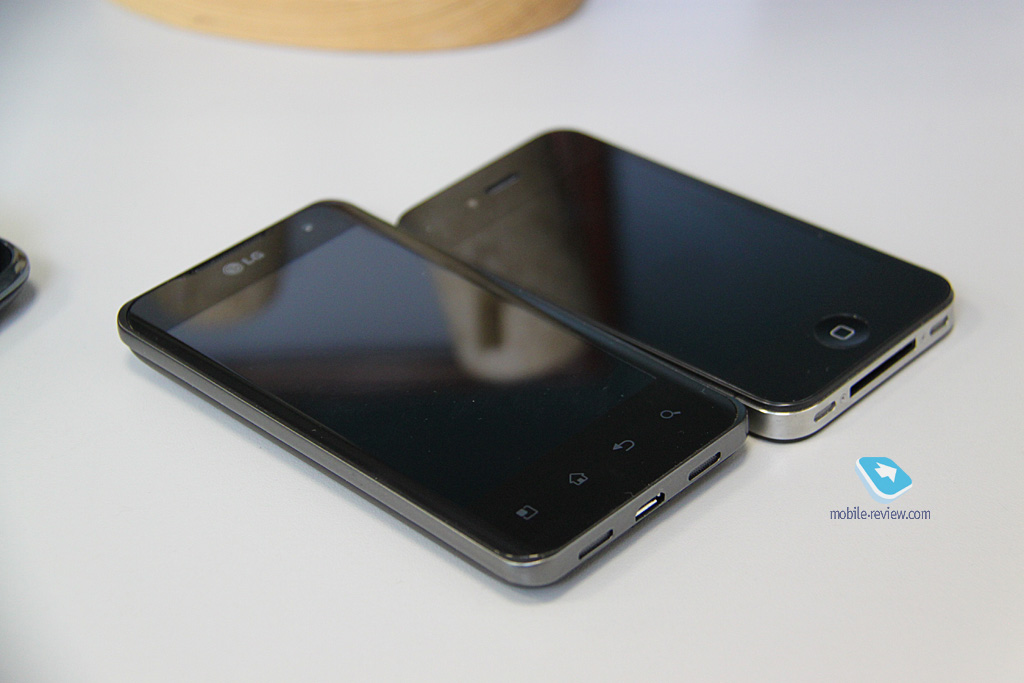
Optimus 2x was unveiled at CES 2011 during the press conference of Nvidia. Its CEO mentioned that the model has industrial design, which is true. It looks like any other rival handset. The build is excellent, but the front side of the model lacks any peculiarity. Do you remember a 3 meter rule from Motorola designers? At this distance people should guess the phone model. Unfortunately, even Motorola abandoned this rule. Look at pictures with Motorola ATRIX 4G at the forefront followed by LG Optimus 2x. Both handsets look similar. We cannot criticize LG for that as it is a general tendency nowadays. Both phones look the same.
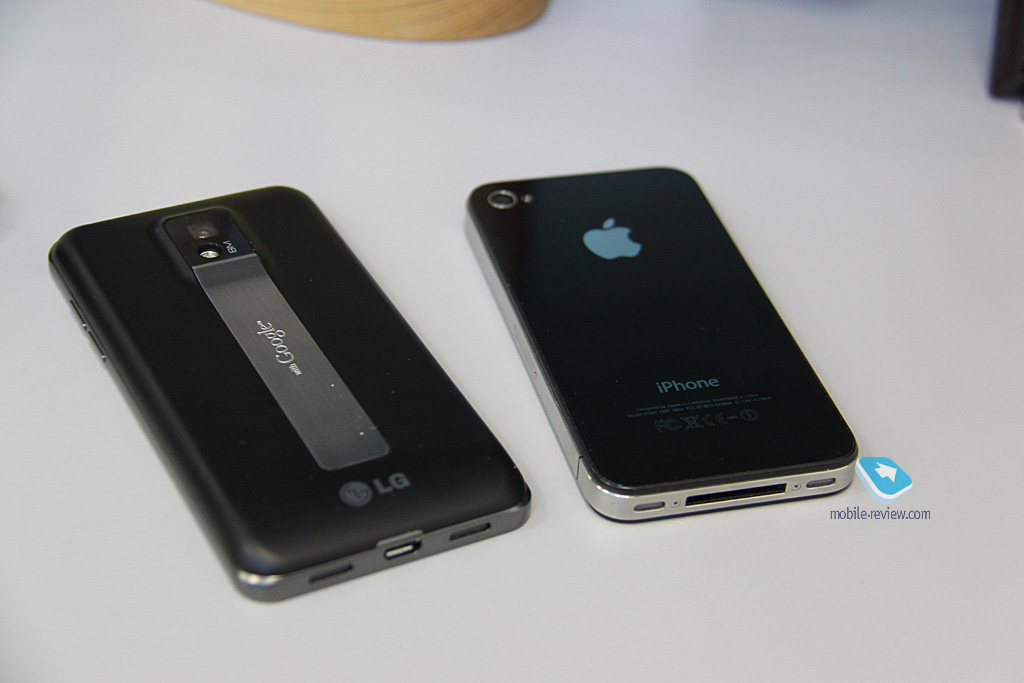
The back panel is equally recognizable. A vertical metal element creates an illusion that the whole panel is made of metal, but it is only plastic. The cover is too thin, but fits well without any looseness.
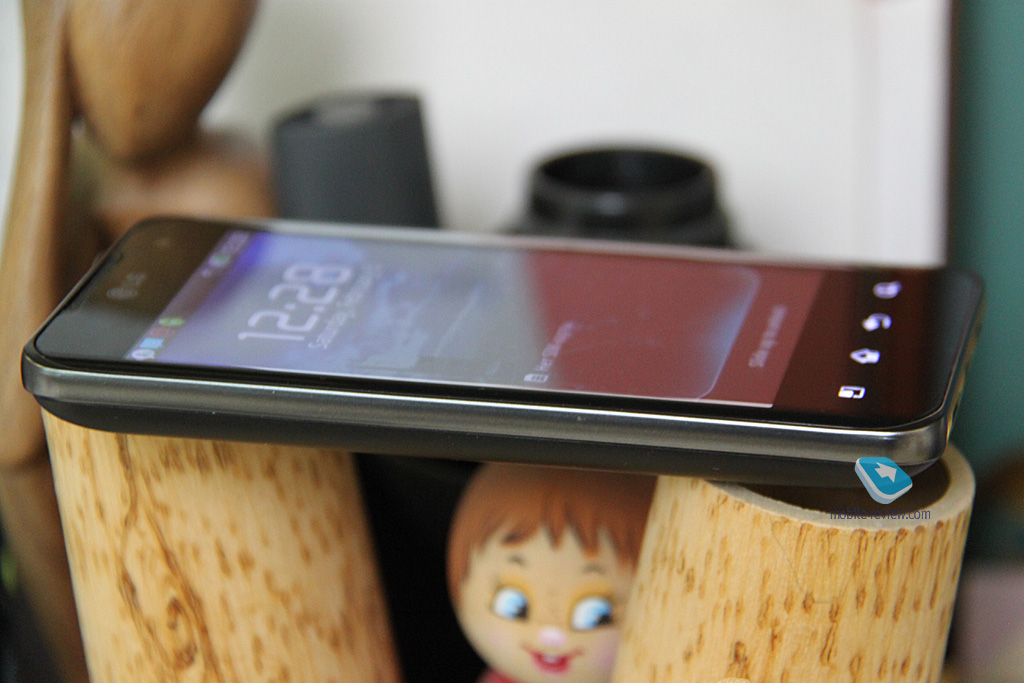
The model weighs 144 g with the dimensions of 123.9х63.2х10.9 mm. It is quite heavy, but my HTC Desire offers 135 g, which is comparable. There is no much difference from rival models - Atrix 4G, Samsung Galaxy S, HTC Desire HD. You get accustomed easily and the phone fits any hand well. It is too broad though.
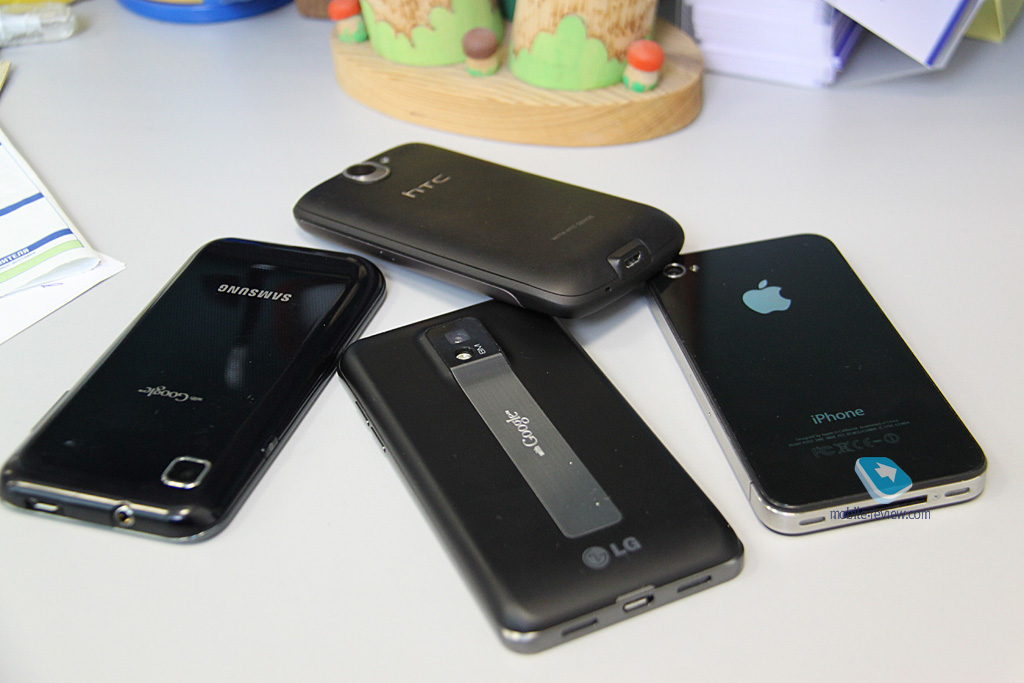
LG Optimus 2x vs Samsung Galaxy S:
LG Optimus 2x vs HTC Desire:
LG Optimus 2x vs Apple iPhone 4:
At the back you have a slightly protruding camera and the handset usually rests on it. On sliding surfaces Optimus 2x can swing easily. Galaxy S sports an upturn at the bottom to prevent siding. Here the back cover is a good launching area for sending the phone falling down. Remember it when you put the phone on a closed laptop or car's dash-board.
The body is well-built, but uses plastic only. The sides have a metal resembling paint, but there is no metal here if you scratch the surface.
The front hosts a grilled speaker and the proximity sensor to the left with the frontal camera to the right. Below the screen are located four sensor keys. All manufacturers now get rid of hardware buttons, which is not convenient, but it is not a serious issue anyway.
Much has been said about the screen protecting plastic. If you look at the list of products on Gorilla Glass website you will not find Optimus 2x there, but if you analyze the features of the material you will end up with something very similar. It can't be scratched, but it is not protected from fingerprints by an oil-repellent surface.
On the right side we see a paired volume rocker, while the top hosts an on/off button responsible for unblocking the phone. A 3.5 jack and an HDMI are covered by plastic caps.
At the bottom we have a microUSB jack together with speakers. During the music playback only one speaker is in active use, but the sound will persist if you cover it with a finger. It becomes feebler, but comes from different sides. Developers managed to ensure that the phone will play music well in different environments.

Screen

After Samsung with Amoled and SuperAmoled technologies everybody tries to emulate them. LG uses a standard TFT matrix similar to several Samsung phones (Wave II, Galaxy S SuperClear TFT). In terms of marketing the screen is not a highlight and has no special name. Quality-wise this screen shows black as grey, which is visible in the menu with much background, but in real life you will not feel the difference. Moreover, this TFT screen offers comparable quality as SuperAMOLED from Galaxy S. The same happened with Wave II and Galaxy S. Test shots reveal that the color reproduction is almost identical. If you don't use a magnifying glass the picture quality will be the same.
A serious difference lies in the energy consumption, which is higher for TFT screens. According to specification SuperAmoled needs 50% of the power. Unfortunately, we cannot take screens out of handsets to compare operation times as any phone is a combination of a processor, memory, screen and so on. There are too many factors for straight comparisons. Nevertheless we carried out several tests. With the maximum brightness for both models we selected identical slideshow pictures. Samsung Galaxy S came out on top with the lead of 35%. Android 2.2 was used in both phones. In the second test we analyzed operation times during video playback (with DSP for video decoding). DSP can influence the outcome as better architecture can compensate inferior screen, but there was no place for a miracle and Samsung won again with 30%.
In fact we can claim that the energy consumption of its TFT screen is the weakest link in LG Optimus 2x.
We also decided to involve Galaxy S 9003 (SuperClear TFT) and carried out the second experiment with the slideshow. The results were different as the Samsung model was in front by only 6.5%. Galaxy S 9003 differs from the original Galaxy S only with its screen, so all developments are influenced by screen power consumption only.
Our experiments show that the picture quality can be the same, but other parameters can be quite different. In the battery section we will mention different power consumption modes.
The screen displays up to 16 million colors with the bright and condensed picture. Viewing angles are convenient, but in the sun the picture fades. There are no flares though. The screen is very close to Galaxy S.
You can customize fonts for a menu as this option is available from the settings. The default fonts allow for up to 14 text lines and several status lines. Fonts are large and easy to read.
The screen resolution is traditional 480х800 with the physical size of 4″ (52х88 mm).
Frankly speaking, we should compare Optimus 2x with Galaxy S2, which has SuperAMOLED Plus. It has even better energy consumption characteristics. These two models will be direct rivals.

Battery

The model comes equipped with a 1500 mAh Li-Ion battery identical to the one in Samsung Galaxy S, which allows carrying out a meaningful test. The results have been mentioned above in the screen section.
The manufacturer claims up to 11.5 hours of talktime (GSM) and up to 760 hours (30 days) on standby. To get the results you need ideal circumstances. The same applies to Galaxy S performance.
We tested both model in similar environments. During the music playback we used the same headphones, maximum volume and selected a cycle playback. Screens and equalizers were disabled, apps were not running in the background mode with the memory cards out (playback from the in-built memory). Optimus 2x offered 31 hours, while Samsung Galaxy S managed only 25 hours. Optimus 2x won by 24%.
During the video playback we used DVDRip with the following characteristics:
Results depended a lot upon screen settings. With the maximum brightness Samsung Galaxy S gave us around 5 hours, while Optimus 2x could produce only 3.5 hours. Automatic adjustment of brightness leveled the difference between the models, but still Galaxy S produced 5.6 hours, when Optimus 2x could come up only with 4 hours.
Data transfer via WiFi (files downloads through the links in indefinite mode with disabled screens) showed parity with both models working during the identical period of time.
3G (download of files in indefinite mode) offered the parity again (4.5 hours). The result depends on the network, coverage quality and phones interference. Interestingly, with the enabled screens the situation was different. The operation time went down by 1 hour and Samsung Galaxy S received an advantage due to lower energy consumption.
All these tests are not vital for consumers, because they don't tell you how long your sample will work in real life. My HTC Desire usually "dies" by 2 pm, while Galaxy S goes strong until the evening (7 pm). The standard workload is 1.5 hours of talktime, 20 SMS, more than 200 read messages, constant EDGE connection for mail, PUSH and Twitter clients. With this scenario I did not notice much difference from Galaxy S. I think it is quite an achievement as the computational power was boosted and it had to influence the power consumption, especially taking into account the type of screen used. Tegra2 allowed keeping this parameter decent.

Memory and memory cards

The handset has 8 GB of memory divided into two disks: a system one (1.5 GB) and another disk for user data (5.5 GB). Hot swappable microSD cards of up to 32 GB can be used as well. The slot is under the back cover. The model also boasts 380 MB of RAM with 110 MB free for users. It does not affect the performance and if necessary the memory can be freed.

Performance

All synthetic tests associated with the performance of Nvidia Tegra2 in comparison with modern flagships are in the separate article.
10:03 PM | 0 Comment | Read More

Followers